NCW Makes POSH Audits Mandatory — What This Means for Kerala Employers
On 19 June 2026, the National Commission for Women (NCW) issued an advisory to every state and union territory in India, calling for stronger, more accountable implementation of the POSH Act, 2013. For Kerala employers, this advisory does something specific and significant: it converts what was, until now, treated as good practice into a defined, district-monitored, annual obligation — with real penalty exposure for non-compliance.
Here is what the advisory says, what it means under the existing law, and what Kerala organizations should do now.
A Functioning IC, Not Just a Constituted One
The advisory makes a distinction that FIO Foundation has been raising with Kerala organizations for two years: an Internal Committee that exists on paper is not the same as an Internal Committee that is legally valid and actually functioning.
For an IC to be legally fit, it must have at least 50% women representation, and — critically — an external member who is genuinely independent and has real expertise in handling cases in the interest of women, ideally drawn from an NGO working in this space. In practice, FIO Foundation has audited many Kerala ICs where the so-called external member is the organization's own lawyer, a family friend of management, or someone with no demonstrated expertise in sexual harassment cases at all. This defeats the entire purpose of Section 4(2)(c), which exists precisely to bring independent, expert oversight into the inquiry process.
The NCW advisory directly addresses this gap. It states plainly that an IC existing only on paper is not sufficient — and that annual audits are now the mechanism to verify whether an IC is genuinely, effectively functioning, not merely constituted.
Organizations can get a preliminary sense of where they stand using FIO Foundation's free POSH Compliance Self-Check tool, available on our website: https://fiofoundation.org/posh-compliance-checker , which scores an organization against 20 mandatory compliance items across all six core compliance areas.
District Collectors Are Now the Named Monitoring Authority
One of the most consequential parts of the advisory, for Kerala specifically, is the formal designation of the District Officer as the nodal authority for implementation, monitoring, awareness generation, and grievance redressal at the district level.
In Kerala, the District Officer under the POSH Act is the District Collector, as designated by Kerala Government Order. This is not a new role created by the advisory — Section 20 of the POSH Act already requires the District Officer to facilitate awareness, partner with NGOs, and ensure POSH Act implementation at the district level. What the advisory does is sharpen and formalize the District Collector's responsibility to actively monitor and verify compliance — not simply hold the role on paper.
For Kerala employers, this means the District Collector's office is no longer a passive, rarely-engaged authority. It is being positioned as an active monitoring and enforcement body.
A New, Separate POSH Audit Requirement
This is the most direct and immediate change for employers. The advisory introduces a mandatory annual POSH audit — separate from and in addition to the existing annual report obligation under Sections 21 and 22 of the Act.
This audit report is to be submitted to the WCD District Officer and the District Collector. The advisory is explicit that non-conduct of this audit is itself to be treated as an act of non-compliance — independently exposing the organization to the penalty provisions under Section 26 (a fine of up to ₹50,000 for a first offence, doubled for repeat violations) and the broader liability framework under Section 28 of the Act.
In practical terms: an organization that has never had its POSH compliance independently audited is now carrying a distinct, named compliance gap — separate from any gap in its annual reporting, IC formation, or training records.
Public Disclosure on Websites — A New Requirement
The advisory requires that details of Internal Committees, Local Committees, Nodal Officers, complaint procedures, email IDs, contact numbers, and online grievance mechanisms be prominently displayed not only on office premises but also on organizational websites.
This is a meaningful shift. The POSH Act's existing notice board requirement under Section 19(b) has historically been interpreted as a physical workplace obligation. Most Kerala organizations that have a properly constituted IC do not currently display any IC information on their public-facing website — because the Act did not explicitly require it. The NCW advisory changes this. Organizations should expect website disclosure of IC details to become a standard compliance expectation going forward.
Annual Reporting — Finally Enforced at the District Level
Section 21(2) of the POSH Act has, since 2013, required District Officers to consolidate the annual reports received from establishments in their district and submit a consolidated report to the State Government. In practice, across most of India including Kerala, this consolidation has rarely happened in any systematic, enforced way.
The NCW advisory directly addresses this enforcement gap. States have been advised to review consolidated reports periodically to assess compliance levels and identify gaps — meaning the District Officer's Section 21(2) obligation is now expected to actually be carried out, not left dormant.
The direct consequence for employers is this: annual reports under Sections 21 and 22 must now be submitted in a genuinely time-bound manner, because District Authorities — both the District Collector and the WCD District Office — have been specifically tasked with reviewing compliance reports and audit findings, identifying non-compliant establishments, conducting periodic review meetings, and leading intensive POSH awareness campaigns at the district level.
An annual report that is prepared late, prepared incompletely, or never actually submitted to the District Officer is now far more likely to be noticed.
Special Scrutiny for Educational and Healthcare Institutions
The advisory specifically calls out universities, colleges, schools, hostels, coaching centres, hospitals, and medical establishments for strengthened POSH compliance — citing the particular vulnerability of students, interns, trainees, research scholars, and contractual staff in these environments.
Educational and healthcare institutions in Kerala should treat this as a direct signal that compliance reviews in their sectors are likely to be prioritized ahead of general commercial establishments.
What Kerala Employers Should Do Now
1. Audit your IC's composition against the 50% women representation standard and verify your external member is genuinely independent and experienced — not your organization's lawyer or someone with no relevant expertise. If you need an independent, expert external member, FIO Foundation provides this service across Kerala.
2. Get an independent POSH audit conducted now. Since non-conduct of the audit is itself treated as non-compliance, an organization that has never had one is exposed regardless of how well its IC otherwise functions.
3. Add IC, complaint procedure, and grievance contact details to your organization's website, not just the office notice board.
4. Confirm your Section 21/22 annual reports have actually been submitted to your District Officer — not just prepared and filed internally. With District Collectors now expected to actively consolidate and review these reports, an unsubmitted report is a more visible gap than before.
5. If you operate in education or healthcare, prioritize your compliance review — these sectors are explicitly named for heightened scrutiny.
6. Use FIO Foundation's free POSH Compliance Self-Check tool on our website to get an initial, no-cost sense of where your organization stands across all 20 mandatory compliance items.
How FIO Foundation Can Help
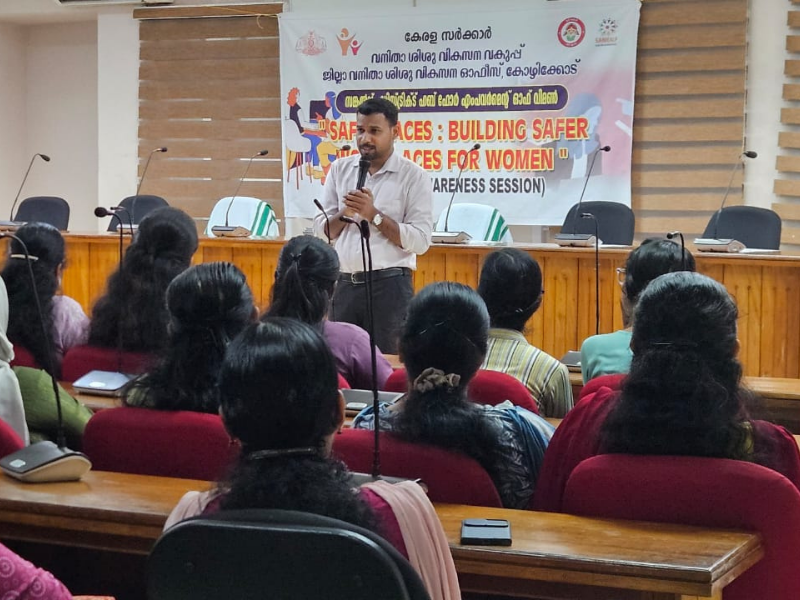
FIO Foundation conducts POSH Audits for Kerala organizations covering exactly the areas this advisory identifies — IC constitution and 50% women representation, independent external member verification, complaint records, confidentiality safeguards, notice board and website disclosure compliance, SHe-Box and Kerala WCD Portal status, and Section 21/22 annual reporting. We also serve as the independent, expert external member for organizations across Kerala — exactly the role the advisory emphasizes is so often filled incorrectly.
If your organization has not yet had a POSH audit, or if you are unsure whether your IC's external member genuinely meets the independence and expertise standard, contact FIO Foundation at +91 99617 71711 or WhatsApp us.
This article is based on the NCW's official press release dated 19 June 2026. FIO Foundation's interpretation and recommendations are independent guidance and do not represent an official position of the National Commission for Women or the Kerala Department of Women and Child Development.
Frequently Asked Questions
What is the NCW POSH audit advisory of June 2026?
On 19 June 2026, the National Commission for Women issued an advisory to all Indian states and union territories recommending mandatory annual POSH audits for every establishment with 10 or more employees. The advisory also calls for state-level monitoring cells, district-level accountability through District Officers, and stronger enforcement of existing POSH Act obligations including Internal Committee functioning, annual reporting, and public disclosure of grievance mechanisms.
Is a POSH audit mandatory in Kerala?
Following the NCW advisory of 19 June 2026, annual POSH audits are expected to become mandatory for every Kerala establishment with 10 or more employees. The advisory states that non-conduct of the audit is itself to be treated as non-compliance under the POSH Act, exposing the organization to penalties under Section 26.
Who is the District Officer under the POSH Act in Kerala?
In Kerala, the District Officer under the POSH Act is the District Collector, as designated by Kerala Government Order. The NCW advisory formalizes the District Collector's role as the nodal authority for POSH implementation, monitoring, awareness generation, and grievance redressal at the district level.
What happens if a company does not conduct a POSH audit?
Under the NCW's 2026 advisory, non-conduct of the mandatory annual POSH audit is itself treated as an act of non-compliance. This can expose the organization to penalties under Section 26 of the POSH Act, which prescribes a fine of up to Rs 50,000 for a first offence, doubled for repeat violations, along with broader liability under Section 28.
Does a POSH Internal Committee need 50% women members?
Yes. The NCW advisory specifies that every Internal Committee must have at least 50 percent women representation, along with a woman Presiding Officer, qualified internal members, and a genuinely independent and expert external member, ideally from an NGO with real experience handling cases in the interest of women.
Should POSH Internal Committee details be published on the company website?
Yes, following the NCW advisory. Internal Committee details, Local Committee information, Nodal Officer contacts, complaint procedures, email IDs, phone numbers, and online grievance mechanisms must now be displayed prominently both on office premises and on the organization's website to ensure accessibility and awareness.
What is the difference between the POSH annual report and the new POSH audit?
The POSH annual report under Sections 21 and 22 of the Act is a yearly summary of complaint numbers prepared by the Internal Committee and submitted to the employer and District Officer. The newly advised POSH audit is a separate, more comprehensive compliance review covering IC functioning, confidentiality safeguards, workplace safety infrastructure, SHe-Box usage, and disclosure compliance, submitted directly to the WCD District Officer and District Collector.
Can FIO Foundation serve as the external member of a Kerala organization's Internal Committee?
Yes. FIO Foundation provides independent, expert external IC member services for organizations across all 14 Kerala districts, fulfilling the Section 4(2)(c) requirement under the POSH Act.
Book a POSH Training Session
FIO Foundation has trained 6000+ professionals across Kerala. Call +91 99617 71711 or message us on WhatsApp.
💬 WhatsApp Us