What Is POSH Act? A Kerala Employer's Guide
The Sexual Harassment of Women at Workplace (Prevention, Prohibition and Redressal) Act, 2013 — called the POSH Act — is a central Indian law that applies to every employer in Kerala with 10 or more employees.
It is not optional. It is not sector-specific. It applies to government offices, private companies, hospitals, schools, NGOs, IT firms, cooperative societies, and every other workplace — regardless of industry, turnover, or how many women currently work there.
Why Was This Law Made?
Before 2013, India had no specific law on workplace sexual harassment. The Supreme Court filled this gap in Vishaka v. State of Rajasthan (1997) — a landmark judgment that issued binding guidelines for employers. The POSH Act of 2013 gave these guidelines the force of law.
The Act came into force on 9 December 2013.
What Does the POSH Act Actually Say?
The Act does three things:
1. It defines sexual harassment Section 2(n) defines sexual harassment as any unwelcome act or behaviour of a sexual nature — including physical contact, demand for sexual favours, sexually coloured remarks, showing pornography, or any other unwelcome physical, verbal, or non-verbal conduct of a sexual nature.
Section 3(2) goes further. Even without a direct sexual act, the following circumstances can amount to sexual harassment:
Implied or explicit promise of preferential treatment in employment
Implied or explicit threat of detrimental treatment in employment
Implied or explicit threat about present or future employment status
Interference with work or creating an intimidating, offensive, or hostile work environment
Humiliating treatment likely to affect health or safety
2. It makes employers legally responsible Section 19 lists the employer's duties — including providing a safe working environment, displaying IC details and consequences of sexual harassment at the workplace, organising awareness training at regular intervals, and ensuring IC members are trained.
3. It creates a complaint and resolution mechanism inside the organisation Every employer with 10 or more employees must form an Internal Committee (IC) under Section 4. This IC receives complaints, conducts inquiries, and recommends action — entirely within the organisation.
What "Workplace" Means Under the POSH Act
Section 2(o) defines workplace broadly. It is not limited to your office building.
It includes any place visited by an employee in connection with work — client offices, project sites, field visits, business travel, and vehicles used for work. It also includes digital workplaces — a WhatsApp message, a Zoom meeting, or a work email can constitute workplace sexual harassment.
In Kerala, every establishment — from an Infopark IT company to a paddy processing unit in Palakkad — falls within this definition if it employs 10 or more persons.
How the POSH Act Protects Your Business — Not Just Your Employees
This is what many Kerala employers miss. The POSH Act is not a burden on business. It is a protection for business.
Without the POSH Act in place: If a sexual harassment incident occurs at your workplace, you have no defined process. The complainant may go directly to the police, to the media, or to court. The incident becomes public. You have no documented response. You face criminal liability exposure and reputational damage simultaneously.
With the POSH Act properly implemented: The complaint is received by your IC — a formal body constituted under law. The inquiry is conducted internally, confidentially, and within a defined 90-day timeline under Section 11(4). The matter is resolved within the organisation. Confidentiality is protected under Section 16. The employer is protected from accusations of inaction. The complainant has a fair, documented process.
The POSH Act gives your organisation a legal framework to handle harassment complaints professionally — before they become legal cases, police complaints, or news stories.
What Kerala Employers Must Do Under the POSH Act
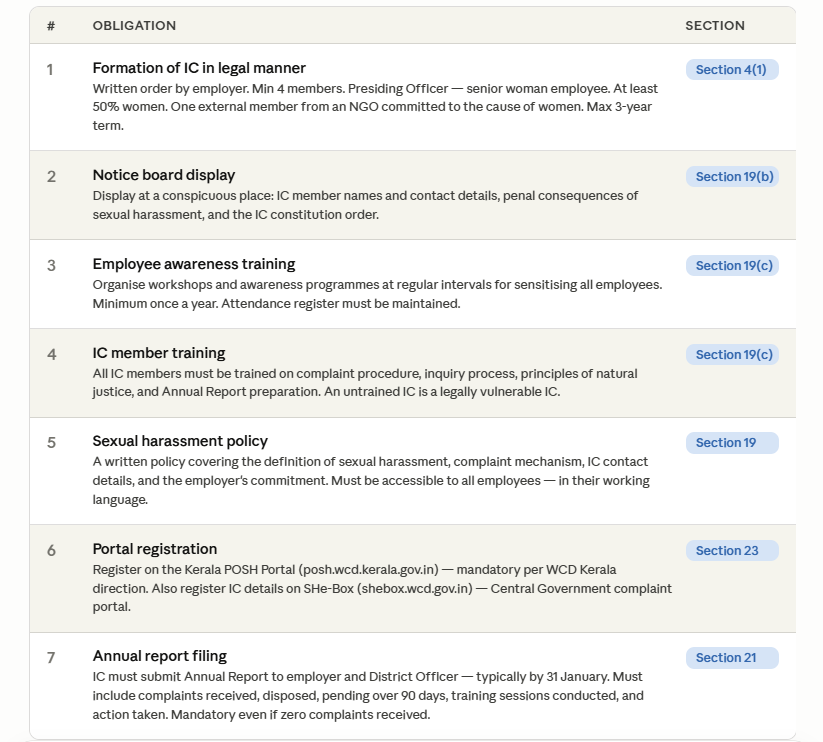
7 employer obligations under the POSH Act 2013 — IC formation, notice board, employee training, IC training, sexual harassment policy, portal registration, and annual report filing
ObligationSectionWhat It MeansForm an Internal CommitteeSection 4Written order, minimum 4 members, at least 50% women, one external member from an NGO committed to the cause of womenDisplay IC details and penal consequencesSection 19(b)Notice board at the workplaceConduct regular employee awareness trainingSection 19(c)At least once a year for all employeesFile Annual Report with District OfficerSection 21By 31 January each yearRegister on Kerala POSH PortalWCD Kerala directionposh.wcd.kerala.gov.in
What Happens If You Do Not Comply
Section 26 of the POSH Act:
First offence: Fine up to ₹50,000
Repeat violation: Double the penalty + possible cancellation of business registration, licence, or government approvals
In Kerala, the Department of Women and Child Development is the nodal agency for POSH Act enforcement. WCD Officers are empowered to verify compliance. Labour Department Officers check POSH compliance during inspections.
IC vs Local Committee — Which Applies to You?
Your organisation has 10 or more employees: You must form an Internal Committee (IC). Complaints are handled within your organisation.
Your organisation has fewer than 10 employees: No IC required. Women employees may file complaints with the Local Committee (LC) constituted by the District Collector of each Kerala district.
FIO Foundation — Kerala's Dedicated POSH Act Organisation
FIO Foundation is Kerala's exclusive NGO for the POSH Act — SHe-Box / WCD Empanelled. We provide:
POSH Employee Awareness Training — Malayalam and English
IC Formation and Training
External IC Member Services — as an NGO committed to the cause of women, FIO Foundation is eligible to serve as the external member under Section 4(2)(c) of the POSH Act
POSH Compliance Audit
Annual Report Guidance
POSH Portal Registration Support
6,000+ professionals trained across all 14 Kerala districts.
📞 +91 99617 71711 🌐 fiofoundation.org 📧 connect@fiofoundation.org
WhatsApp us with "POSH Compliance" and we will assess your organisation's status — free of charge.
Frequently Asked Questions
Does the POSH Act apply if no women work in my organisation?
Yes. The obligation to form an IC and comply with the POSH Act exists regardless of whether women are currently employed. The framework must be ready before a woman joins — not after a complaint arises.
Does the POSH Act apply to remote or work-from-home employees?
es. Section 2(o) defines workplace broadly to include any place visited in connection with work. Digital workplaces — video calls, messaging platforms, and work-related communication — fall within this definition.
Is the POSH Act a central law or a Kerala-specific law?
The POSH Act is a central law — Act No. 14 of 2013 — applicable across all of India including Kerala. In Kerala, the Department of Women and Child Development is the nodal agency for implementation and enforcement. WCD Kerala has additionally established the Kerala POSH Portal (posh.wcd.kerala.gov.in) for mandatory compliance registration.
What is the difference between the POSH Act and SHe-Box?
The POSH Act is the law. SHe-Box (shebox.wcd.gov.in) is the Central Government's online portal where women can file complaints — which are then routed to the appropriate IC or Local Committee.
Can a contract worker file a POSH complaint?
Yes. The definition of "employee" under Section 2(f) of the POSH Act includes persons employed directly or through an agent, whether temporary, ad hoc, daily wage, contractual, or on a voluntary basis.
Book a POSH Training Session
FIO Foundation has trained 6000+ professionals across Kerala. Call +91 99617 71711 or message us on WhatsApp.
💬 WhatsApp Us